Clean Screen DAU cartridges used in validated method for substances prohibited in racehorse urine
Horse racing is a multi-million dollar industry. To uphold the safety and integrity of the sport, the International Federation of Horseracing Authority (IFHA) establishes prohibited substances that are regulated for use in racehorses. These substances are varied and numerous, and the responsibility of their identification falls onto antidoping toxicology labs. An antidoping lab in Turkey recently published a validated method for identification of 63 prohibited substances in racehorse urine. The analytes included in the method include various classes such as anesthetics, analgesics, sedatives, opioids, beta-blockers, stimulants, anti-inflammatories, and more. To extract the analytes of interest from horse urine, samples were first carried through hydrolysis. 14 mL of urine were mixed with internal standard, 1 M phosphate buffer (pH 5.8), ammonium sulfate, protease, and beta-glucuronidase before incubation for 1.5 hours at 55 o C. 7 mL of sample was then transferred, centrifuged, diluted with phosphate buffer and water, and adjusted to pH 7 with 10% NaOH before extraction by solid phase
extraction (SPE).
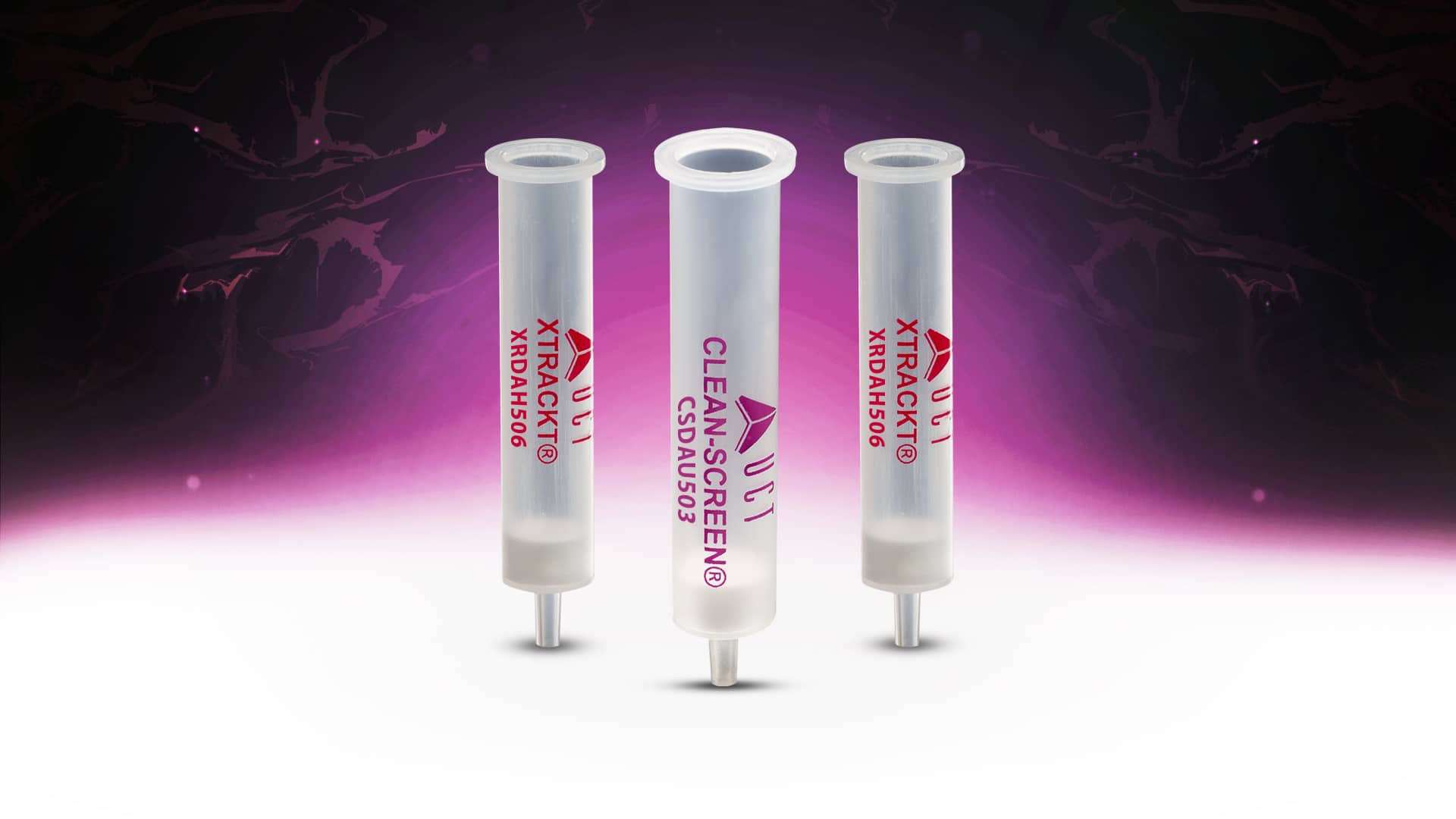
Automated SPE was performed on a Gilson Aspect GX-274. Clean Screen DAU 500 mg, 3 mL cartridges (CSDAU503) were conditioned with water, methanol, and phosphate buffer
(0.1 M, pH 6). The sample was applied and then cartridges were washed with 1 M acetic acid and methanol with drying steps after each wash. Elution of analytes was performed using a mixture of ethyl acetate and aqueous ammonia (97:3 v/v). Samples were then evaporated and reconstituted for analysis by LC-MS/MS. During development, clogging of the SPE cartridges became an issue. Researchers found this was avoided by adding protease during hydrolysis and precipitating proteins with ammonium sulfate. However, column clogging during extraction can also be combatted by using UCT’s large particle size XtrackT® columns. These columns offer better and more consistent flow for viscous and dirty samples, such as horse urine.
This extraction method was paired with an LC-MS/MS method that successfully fulfilled validation criteria according to 2021/808/EC guidelines. Established screening limits and low limits of detection were achieved for all substances. For quantitative analytes, matrix effects ranged from -17.88% to 19.7% showing that major matrix components were effectively removed by the SPE procedure. Selectivity and specificity tests were performed, and no interferences were detected, which also highlights the extraction’s success.
The Clean Screen DAU phase is an effective option when trying to clean up complicated matrices and extract substances of varying chemistries. This phase is also offered in UCT’s XtrackT® large particle columns. The XtrackT® DAU column was previously used to extract 89 banned or controlled racing industry drugs in horse urine. If you are an antidoping laboratory or horse racing laboratory, consider Clean Screen DAU or XtrackT® DAU for your extractions!
Reference: Kabil, E., Göktaş, E.F. Development and Validation of Confirmatory Quantitative and
Screening Methods for 63 Prohibited Substances in Horse Urine Using LC–MS/MS. Chromatographia
88, 151–168 (2025). https://doi.org/10.1007/s10337-024-04384-2