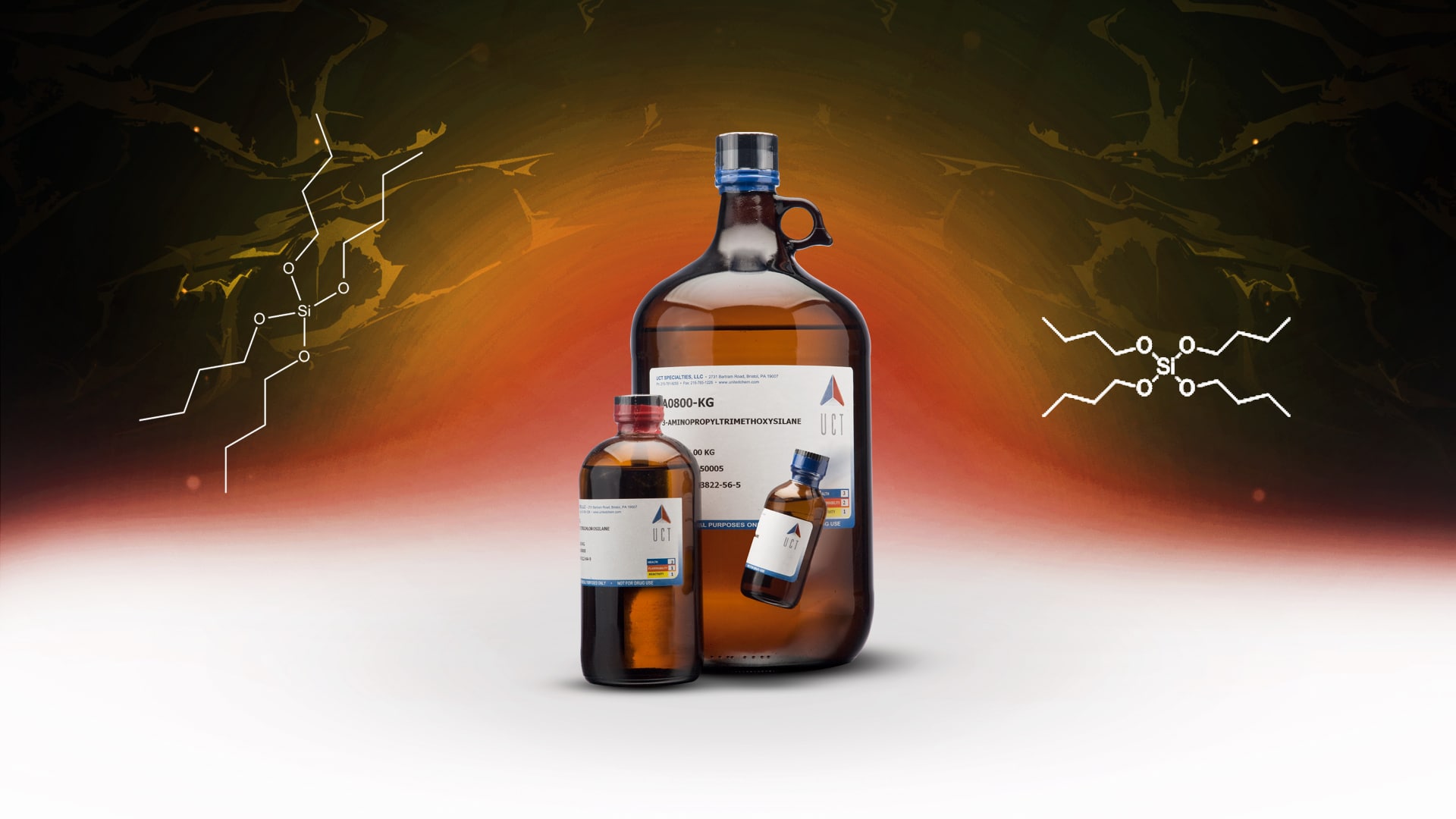
UCT Product Spotlight: Tetrabutoxysilane in Controlled Hydrogel Bead Formation
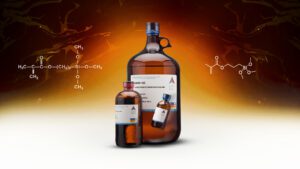
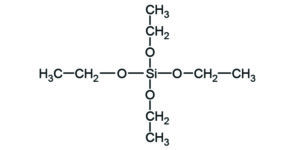
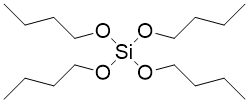
Tetrabutoxysilane (aka Tetrabutyl orthosilicate) (T1750)
Reliable control of hydrogel bead size remains a central challenge in high-value applications such as bioprinting, drug delivery, and bioremediation, where bead diameter directly influences transport properties, structural integrity, and functional performance. Even small variations in formulation or operating conditions can significantly alter droplet formation behavior, making reproducibility a persistent barrier to scale-up.
In a recent study researchers from the University of Chicago, Oregon State University, and Carnegie Mellon University addressed this challenge by developing a predictive framework for droplet-based hydrogel bead formation using a “Map of Misery” approach. This framework maps formulation and operating conditions to regimes of stable, unstable, and failed droplet formation—providing a practical route to reduce empirical tuning in bead production.
A key component in this work is tetrabutoxysilane (aka tetrabutyl orthosilicate; T1750), supplied by UCT. Used in one of the two hydrogel precursor solution models, TBOS serves as a functional slow-release agent, in addition to influencing the fluid properties of the precursor solution itself. A second simplified model—which uses titanium dioxide for imaging and excludes organic additives which provides a different set of fluid properties—further supports the robustness of the mapping framework across different hydrogel system designs .
By analyzing these two models, the researchers demonstrate that bead formation behavior can be tuned more predictably across operating conditions, effectively reducing reliance on system-specific calibration and enabling a more generalized approach to achieving target bead sizes. The study shows that operating within defined regions of the Map of Misery allows for reliable prediction of bead formation outcomes without extensive trial-and-error optimization. While the framework is currently limited to the explored formulation space, it represents a significant step toward more transferable design rules for hydrogel bead production.
For UCT, this work highlights the practical value of TBOS as more than a laboratory reagent—it functions as a controllable chemistry modifier that enables researchers to create real-life models which can be used to improve precision in droplet-based manufacturing systems.
References
Harris, C. G.; Bandettini K. D.; Gedde H. K.; Semprini L.; Fogg K. C.; Rochefort W. E. Spheres, tears, and spears: Regulating the perimeter and circularity of millimeter-sized alginate hydrogel beads. AIChE J. 2026;e70279
https://aiche.onlinelibrary.wiley.com/doi/pdf/10.1002/aic.70279