Eliminating Chlorophyll Interference in Pesticide Testing with ChloroFiltr®
Monitoring pesticide residues in samples with high chlorophyll content, such as leaves, stems, and other green plant tissues, requires meticulous sample preparation. These plant matrices contain not only chlorophyll but also waxes and other co-extractable compounds that can interfere with LC-MS/MS or GC-MS/MS analysis, causing signal suppression, increased background noise, or other analytical interferences. Chlorophyll, in particular, is challenging because it is non-volatile and thermally unstable. For instance, during gas chromatography (GC) analysis, residual chlorophyll can accumulate in the inlet and column, creating active sites that promote analyte degradation and result in poor peak shapes or inconsistent quantification. Such buildup not only compromises analytical accuracy but can also reduce instrument performance and column lifespan. Efficient chlorophyll removal during sample preparation is therefore crucial to maintain method robustness and ensure reliable data.
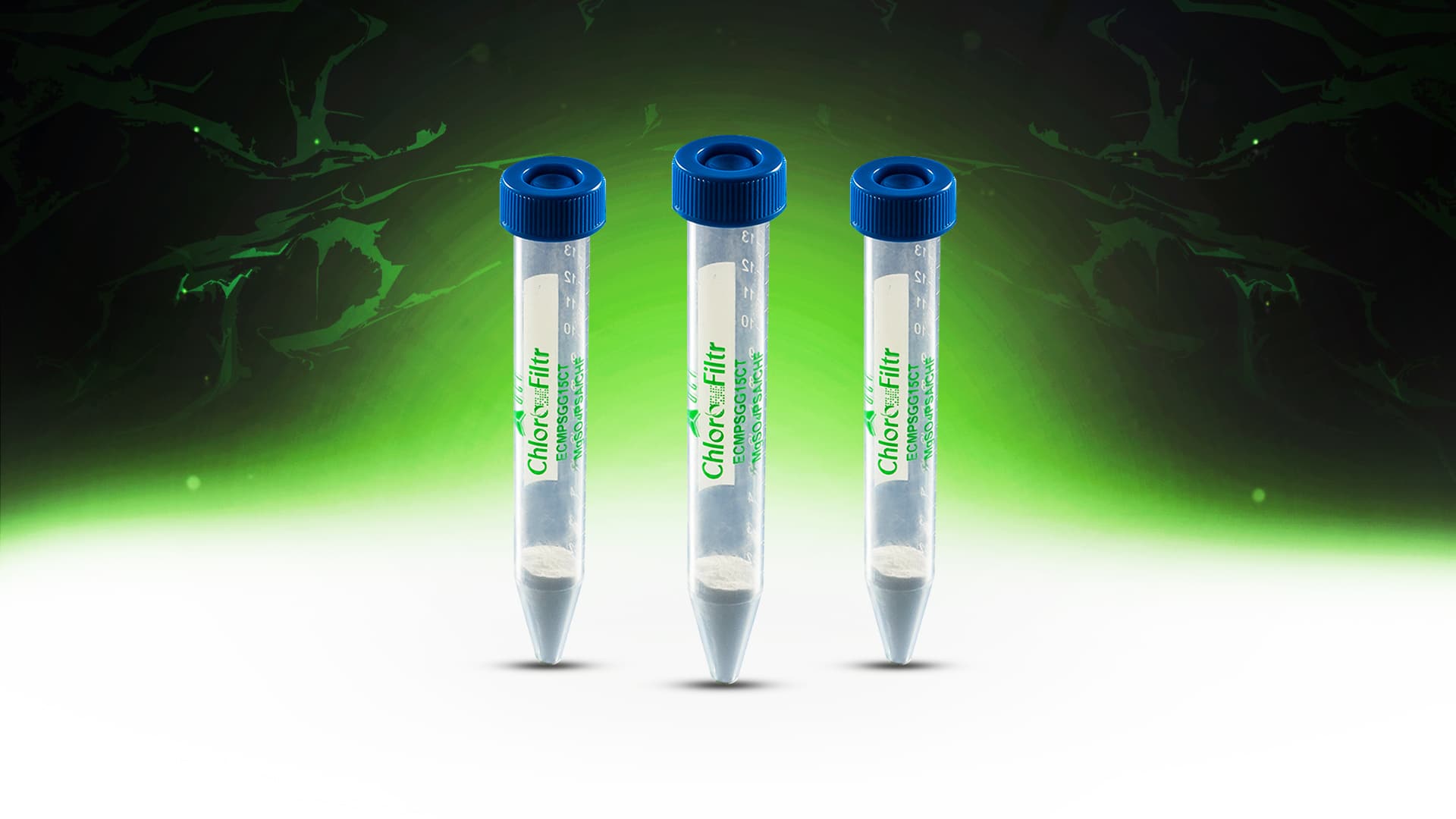
As a sample preparation solution for removing chlorophyll, UCT offers ChloroFiltr®, a polymer-based clean-up sorbent specifically developed to overcome the limitations of traditional materials. While graphitized carbon black (GCB) has been widely used for pigment removal in fruit and vegetable extracts, it can strongly retain planar pesticides leading to poor recoveries.2 ChloroFiltr® was specifically designed to eliminate chlorophyll from QuEChERS acetonitrile extracts without compromising recovery of these critical pesticide classes.
ChloroFiltr® has been used in the cleanup step of various studies analyzing hundreds of pesticides, providing consistent chlorophyll removal while preserving target analytes.3-5 This combination of efficient pigment removal and reliable analyte recovery makes ChloroFiltr® a versatile and robust solution for high-chlorophyll sample matrices. It is available in formats such as dispersive solid-phase extraction (dSPE), push-through cartridges, and SpinFiltr® centrifuge devices to fit different laboratory workflows.
References
Demard, E.; Schumann, R.; van Santen, E.; Diepenbrock, L. Degradation and Residual Efficacy of Insecticides in Citrus Under Protective Screen (CUPS) Differ from Traditional Citrus Orchard. J. Econ. Entomol. 2025, toaf253. DOI: 10.1093/jee/toaf253.
Pszczolińska, K.; Wilk, M.; Kaczmarek, Ł.; Baranowska, I.; Nowak, M. The Pesticide Residue Analysis in Commodities with High Chlorophyll Content. J. Sep. Sci. 2022, 45, 1234–1245. DOI: 10.1002/jssc.202100304.
Walorczyk, S.; Drożdżyński, D.; Kierzek, R. Determination of pesticide residues in samples of green minor crops by gas chromatography and ultra‑performance liquid chromatography coupled to tandem quadrupole mass spectrometry. Talanta 2015, 132, 197‑204. DOI: 10.1016/j.talanta.2014.11.066.
Perestrelo, R.; Silva, P.; Porto‑Figueira, P.; Pereira, J. A. M.; Silva, C.; Medina, S.; Câmara, J. S. QuEChERS – Fundamentals, Relevant Improvements, Applications and Future Trends. Anal. Chim. Acta 2019, 1070, 1–28. DOI: https://doi.org/10.1016/j.aca.2019.02.036
Pszczolińska, K.; Wilk, M.; Kaczmarek, Ł.; Baranowska, I.; Nowak, M. The pesticide residue analysis in commodities with high content of chlorophyll based on the Quick, Easy, Cheap, Effective, Rugged and Safe method: A review. J. Sep. Sci. 2022, 45, 149–165. DOI: 10.1002/jssc.202100304