Organophosphate Flame Retardants: Health Risks and a Suggested SPE Protocol
When you bring a new couch with comfortable, firm cushioning into your home, you can expect that it has been treated to meet flammability standards. In a fire, polyurethane
foam in upholstered furniture without flame retardant treatment can ignite easily and support rapid flame spread – synthetic fibers can melt and fuel combustion. Although fire
is certainly dangerous, the chemicals used in these treatments also pose their own risks.
Concerns first emerged in the 1970s about the persistence, bioaccumulation, and toxicity of polybrominated diphenyl ethers (PBDEs), which had been widely used as flame retardants in upholstered products. Regulatory agencies and manufacturers began phasing them out in the early 2000s. Organophosphate flame retardants (OPFRs) were chosen as replacements and offered performance, availability, and perceived safety compared to the compounds they replaced. But, as monitoring studies became more widespread through the 2010s, researchers began detecting OPFRs consistently in indoor dust, surface waters, wastewater, and even human samples.
Toxicological studies also started to show that certain OPFRs could be associated with endocrine disruption, neurodevelopmental effects, and potential carcinogenicity.
Overall, the findings shifted the perception of OPFRs from safer alternatives to chemicals of emerging concern that still require careful evaluation. Based on the chemistry of the analytes, UCT’s highly cross-linked divinylbenzene (HLD) polymeric sorbent is a reliable choice for testing OPFRs in water samples.
Sample Preparation by SPE and GC-MS Analysis of Organophosphate Flame Retardants:
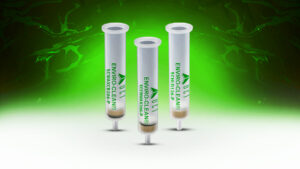
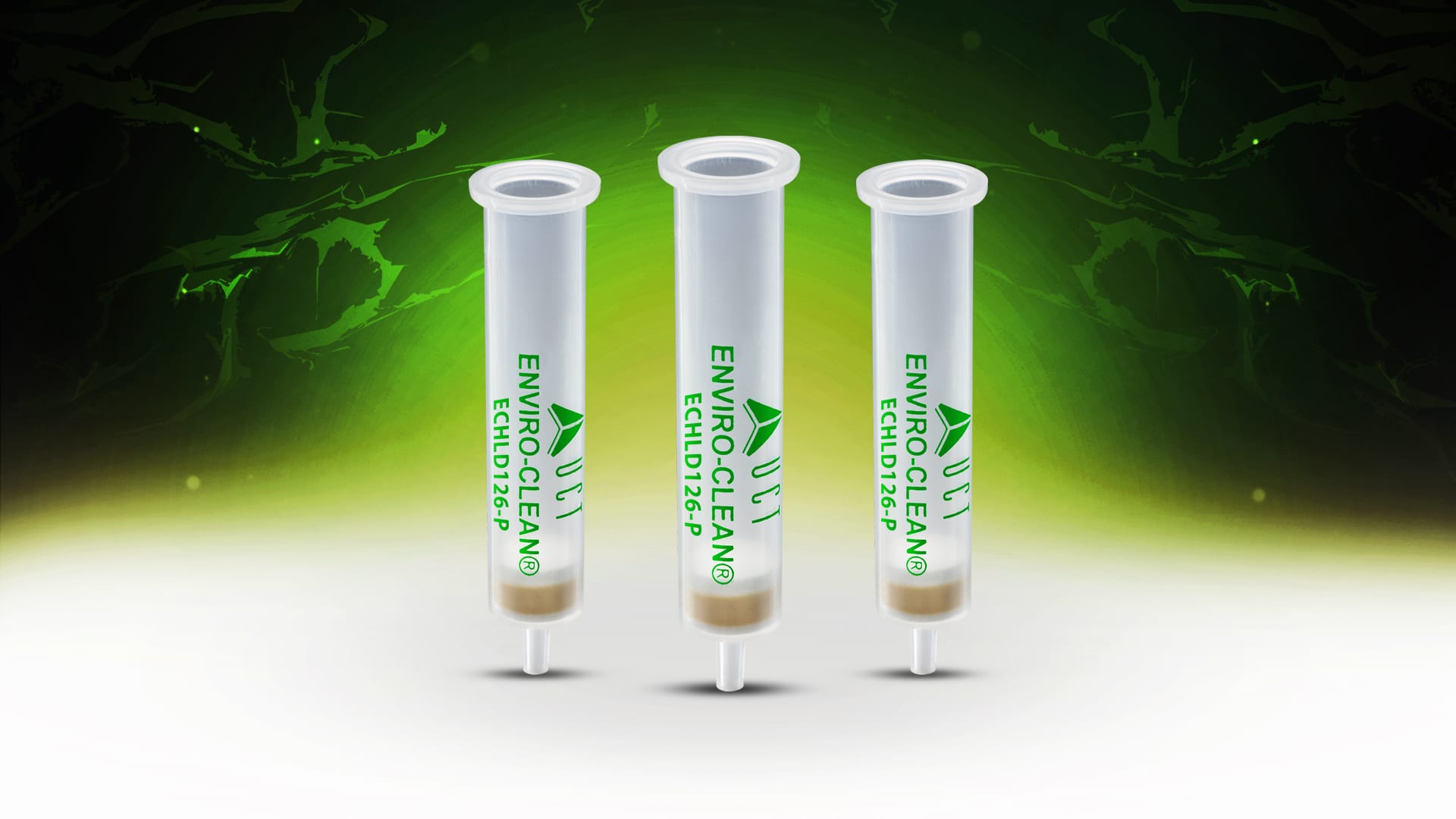
Suggested Protocol Product: ECHLD126-P Enviro-Clean® HL DVB PE Frits 200 mg 6 mL
1) Sample Pretreatment
a) Adjust pH of sample between 2-3 with 6N sulfuric acid
2) SPE Procedure
a) Wash with 5mL ethyl acetate
b) Condition with 5mL methanol
c) Equilibrate with 5mL Water
d) Load sample
e) Rinse the bottle twice with 5 mL reagent water & add to cartridge, twice (This
step is crucial, as highly hydrophobic compounds such as EDHPP and TEHP can
adsorb onto glass surfaces)
f) Wash the cartridge with 2.0mL of reagent water, twice
g) Dry at maximum vacuum for 10-20 minutes
h) Place collection tubes in manifold
i) Rinse the sides of sample bottle with 2mL 1:1 ethyl acetate:dichloromethane, and
transfer onto the SPE cartridge under low vacuum
j) Elute 2 mL of 1:1 ethyl acetate:dichloromethane. Repeat three times.
k) Apply maximum vacuum for 30 seconds
l) Dry extract through sodium sulfate into a concentrator tube
m) Evaporate to ~800uL
n) Bring to 1mL with dichloromethane
o) Analyze by GC-MS-SIM
References:
Hu, Y.; Li, P.; Yin, X.; Ban, D. Determination of Organophosphorus Flame Retardants in Surface Water by Solid Phase Extraction Coupled with Gas Chromatography–Mass Spectrometry. Chin. J. Anal. Chem. 2012, 40 (11), 1693–1697. DOI: 10.1016/S18722040(11)605860.
Rodil, R.; Quintana, J. B.; Reemtsma, T. Liquid Chromatography–Tandem Mass Spectrometry Determination of Nonionic Organophosphorus Flame Retardants and Plasticizers in Wastewater Samples. Anal. Chem. 2005, 77 (10), 3083–3089. DOI: 10.1021/ac048247s.
Li, J.; Yu, N.; Zhang, B.; Jin, L.; Li, M.; Hu, M.; Zhang, X.; Wei, S.; Yu, H. Occurrence of Organophosphate Flame Retardants in Drinking Water from China. Water Res. 2014, 54, 53–61.
DOI: 10.1016/j.watres.2014.01.031.