
EPA Method 537.1
Determination of Selected Per- and Polyfluorinated Alkyl Substances in Drinking Water by Solid Phase Extraction and LC/MS/MS
What Is EPA Method 537.1?
EPA Method 537.1 is an analytical method for the determination of selected per- and polyfluoroalkyl substances (PFAS) in drinking water using solid phase extraction (SPE) and liquid chromatography/tandem mass spectrometry (LC-MS/MS). The method targets 18 PFAS compounds, including perfluoroalkyl carboxylic acids (PFCAs), perfluoroalkyl sulfonic acids (PFSAs), and select precursor compounds.
EPA 537.1 expands on the original EPA Method 537 (14 compounds) by adding four additional analytes — HFPO-DA (GenX), ADONA, 9Cl-PF3ONS, and 11Cl-PF3OUdS — to provide broader coverage of emerging PFAS compounds of regulatory concern. The method extracts PFAS from drinking water samples using styrene-divinylbenzene (SDVB) solid-phase extraction cartridges, followed by methanol elution and LC-MS/MS analysis in negative-ion electrospray ionization mode.
- Targets 18 PFAS compounds including PFOA, PFOS, GenX (HFPO-DA), and ADONA
- Validated for finished drinking water matrices
- Uses SDVB (styrene-divinylbenzene) SPE for extraction
- LC-MS/MS detection with negative-ion ESI and MRM transitions
- Requires PTFE-free labware throughout the entire analytical workflow
Why UCT for EPA 537.1?
Complete sample preparation and chromatography solutions for PFAS in drinking water.
UCT’s Enviro-Clean® DVB and HL DVB SPE cartridges are manufactured with polyethylene frits — not PTFE — to prevent fluoropolymer background contamination in PFAS analysis. Both sorbents deliver excellent recoveries (70–110%) for all 18 analytes at trace-level concentrations. Paired with Selectra® C18 HPLC columns, including a delay column to separate system PFAS contamination from sample analytes, UCT provides a complete sample-to-detection workflow for EPA 537.1. Browse the complete PFAS product catalog for additional cartridge sizes and accessories.
PTFE-Free SPE
PE frits eliminate fluoropolymer contamination pathways for accurate trace-level PFAS analysis
Proven Recoveries
70–110% recovery with <10% RSD for all 18 analytes at 2.5 and 10 ng/L fortification levels
Expanded Coverage
18 PFAS including GenX, ADONA, and chlorinated ether sulfonates beyond EPA 537
Target Analytes & MRM Transitions
18 PFAS compounds analyzed by EPA Method 537.1 with retention times and mass transitions.
| Analyte | R.T. (min) | Precursor Ion | Fragment Ion 1 | Fragment Ion 2 | R² |
|---|---|---|---|---|---|
| PFBS | 2.13 | 299.0 | 79.9 | 99.0 | 0.9989 |
| PFHxA | 2.67 | 313.0 | 269.1 | 118.9 | 0.9971 |
| HFPO-DA (GenX) | 2.89 | 285.0 | 169.0 | 185.1 | 0.9986 |
| PFHpA | 3.42 | 362.8 | 319.1 | 169.1 | 0.9987 |
| PFHxS | 3.47 | 399.0 | 80.0 | 99.0 | 0.9979 |
| ADONA | 3.52 | 377.1 | 251.0 | 85.0 | 0.9982 |
| PFOA | 4.21 | 412.8 | 369.1 | 169.2 | 0.9976 |
| PFOS | 4.95 | 499.1 | 80.0 | 99.0 | 0.9979 |
| PFNA | 4.95 | 463.1 | 419.0 | 219.2 | 0.9978 |
| 9Cl-PF3ONS | 5.33 | 530.9 | 351.0 | — | 0.9980 |
| PFDA | 5.61 | 513.1 | 468.9 | 219.1 | 0.9988 |
| NMeFOSAA | 5.90 | 569.7 | 418.9 | 482.9 | 0.9989 |
| PFUnA | 6.19 | 563.1 | 518.9 | 268.8 | 0.9984 |
| NEtFOSAA | 6.20 | 584.1 | 419.1 | 526.1 | 0.9967 |
| 11Cl-PF3OUdS | 6.45 | 631.1 | 451.0 | — | 0.9977 |
| PFDoA | 6.70 | 612.9 | 569.0 | 319.1 | 0.9980 |
| PFTrDA | 7.14 | 662.9 | 618.9 | 162.2 | 0.9918 |
| PFTA | 7.53 | 713.0 | 668.9 | 169.1 | 0.9981 |
SPE Procedure
Step-by-step solid phase extraction protocol for EPA Method 537.1 using Enviro-Clean® SDVB cartridges.
Sample Pretreatment
Collect samples in a 250 mL polypropylene bottle with a polypropylene screw cap. All field and QC samples (including LRB, LFB, and FRB) must contain the dechlorinating agent specified in Section 8.1.2 of Method 537.1 (Trizma 5 g/L).
SPE Conditioning
- Rinse each cartridge with 15 mL of methanol
- Rinse the cartridge with 18 mL of reagent water — do not allow the water to drop below the top edge of the packing
- Add 4–5 mL of reagent water to the cartridge reservoir
Sample Extraction & Drying
- Attach a large-volume sample transfer tube to the top of each SPE cartridge; place the stainless-steel end directly into the sample bottle
- Ensure transfer tubes are adequately rinsed with methanol prior to use
- Adjust the vacuum so that the flow rate is approximately 10–15 mL/min
- After the entire sample has passed through, rinse the bottle with 2 × 7.5 mL of reagent water and draw through the cartridge
- Dry the cartridge under high vacuum (15–20 in Hg) for 5 minutes
Elution
- Insert a collection rack with 15 mL polypropylene tubes into the extraction manifold
- Add 4 mL methanol to the sample container, cap and thoroughly rinse the sides (important for long-chain hydrophobic PFAS recovery)
- Pull the elution solvent through the sample transfer tubes and cartridges at a low vacuum (dropwise flow)
- Repeat the bottle rinse and cartridge elution with a second 4 mL aliquot of methanol
Concentration & Reconstitution
- Concentrate the extract to just dryness under a gentle stream of nitrogen in a heated water bath (60–65 °C)
- Reconstitute the extract with 1.0 mL of 96:4 methanol:reagent water (v/v) and IS PDS
- Vortex and transfer an aliquot to a polypropylene autosampler vial (PTFE-free)
LC-MS/MS Conditions
Chromatographic and mass spectrometry parameters used for EPA 537.1 analysis.
HPLC Parameters
Mobile Phase Gradient
| Time (min) | A: 20 mM NH₄OAc (%) | B: Methanol (%) |
|---|---|---|
| 0.0 | 95 | 5 |
| 0.5 | 50 | 50 |
| 7.5 | 5 | 95 |
| 8.5 | 5 | 95 |
| 8.6 | 95 | 5 |
| 11.0 | 95 | 5 |
MS/MS Parameters
Delay Column Note: A short C18 delay column is installed after the solvent mixer and before the sample injector to separate any PFAS contamination from the mobile phase, solvent lines, and online degasser from the actual sample analytes. All PTFE solvent lines should be replaced with PEEK tubing.
SPE Recovery Results
Method performance data for Enviro-Clean® SDVB cartridges in reagent water.
| Analyte | Recovery (%) Low | RSD (%) Low | Recovery (%) High | RSD (%) High |
|---|---|---|---|---|
| PFBS | 93 | 5 | 97 | 2 |
| PFHxA | 82 | 3 | 89 | 2 |
| HFPO-DA | 75 | 4 | 72 | 4 |
| PFHpA | 81 | 4 | 91 | 1 |
| PFHxS | 108 | 4 | 96 | 1 |
| ADONA | 77 | 3 | 88 | 1 |
| PFOA | 85 | 4 | 93 | 1 |
| PFOS | 99 | 4 | 90 | 2 |
| PFNA | 82 | 3 | 101 | 1 |
| 9Cl-PF3ONS | 91 | 3 | 98 | 2 |
| PFDA | 84 | 2 | 105 | 1 |
| PFUnA | 85 | 1 | 106 | 1 |
| 11Cl-PF3OUdS | 88 | 4 | 95 | 2 |
| PFDoA | 81 | 3 | 93 | 1 |
| N-EtFOSAA | 77 | 4 | 81 | 2 |
| N-MeFOSAA | 108 | 2 | 87 | 3 |
| PFTA | 80 | 2 | 93 | 2 |
| PFTrDA | 79 | 5 | 89 | 1 |
Low Fortification: 2.5 ng/L (n=4) | High Fortification: 10 ng/L (n=4) — Reagent water
| Analyte | Recovery (%) | RSD (%) |
|---|---|---|
| PFBS | 96 | 2 |
| PFHxA | 96 | 2 |
| HFPO-DA | 86 | 4 |
| PFHpA | 95 | 3 |
| PFHxS | 101 | 2 |
| ADONA | 93 | 3 |
| PFOA | 95 | 3 |
| PFOS | 96 | 3 |
| PFNA | 101 | 3 |
| 9Cl-PF3ONS | 92 | 3 |
| PFDA | 99 | 5 |
| PFUnA | 98 | 5 |
| 11Cl-PF3OUdS | 95 | 3 |
| PFDoA | 92 | 3 |
| N-EtFOSAA | 98 | 2 |
| N-MeFOSAA | 106 | 4 |
| PFTA | 87 | 4 |
| PFTrDA | 85 | 3 |
One-Point Fortification: 5 ng/L (n=4) — Reagent water
Recommended Products for EPA Method 537.1
UCT offers a complete range of consumables designed to meet EPA Method 537.1 requirements.
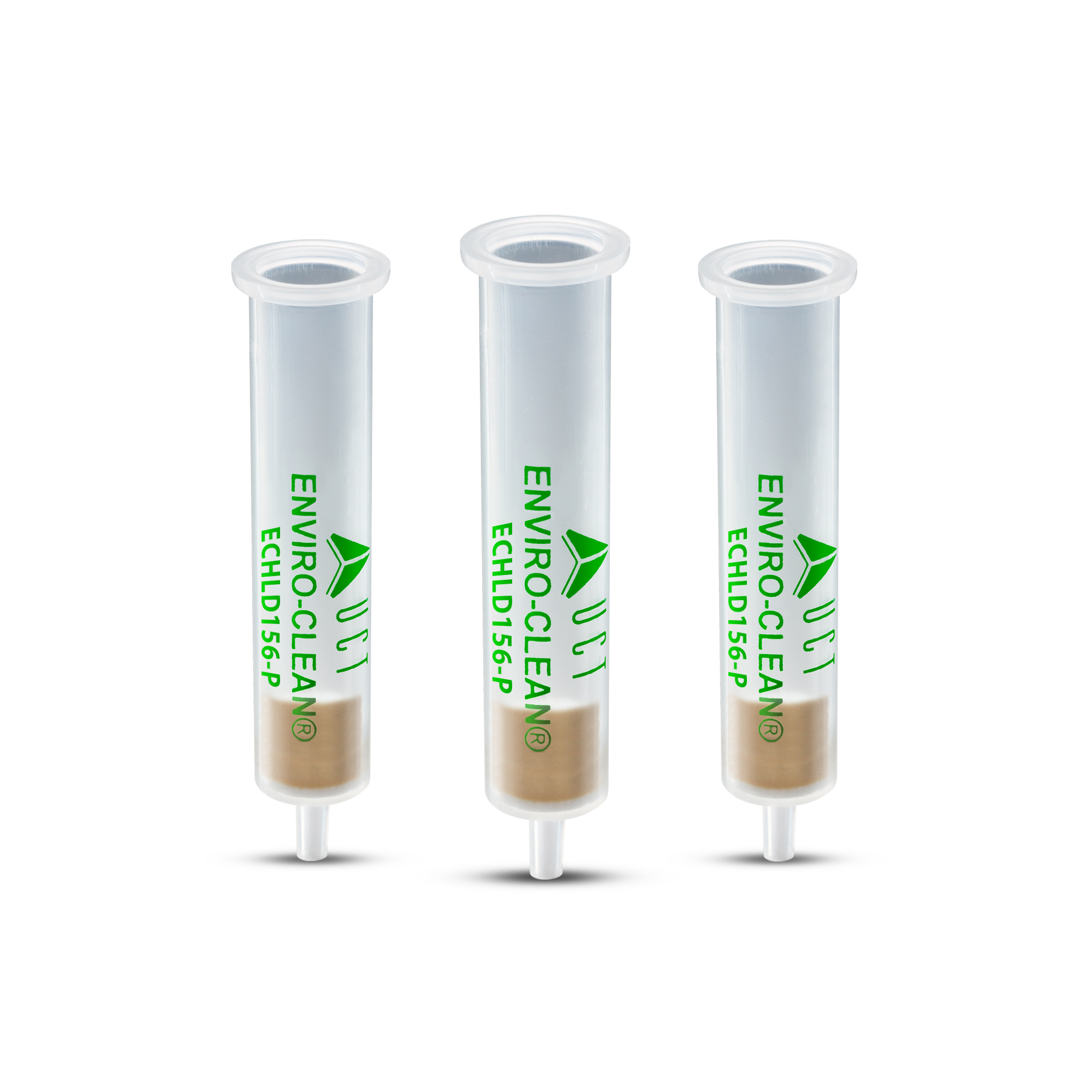
Enviro-Clean® HL DVB PE Frits 500 mg 6 mL
Highly cross-linked DVB with polyethylene frits (ECHLD156-P). Recommended for EPA 537.1 PFAS extraction from drinking water.
View Product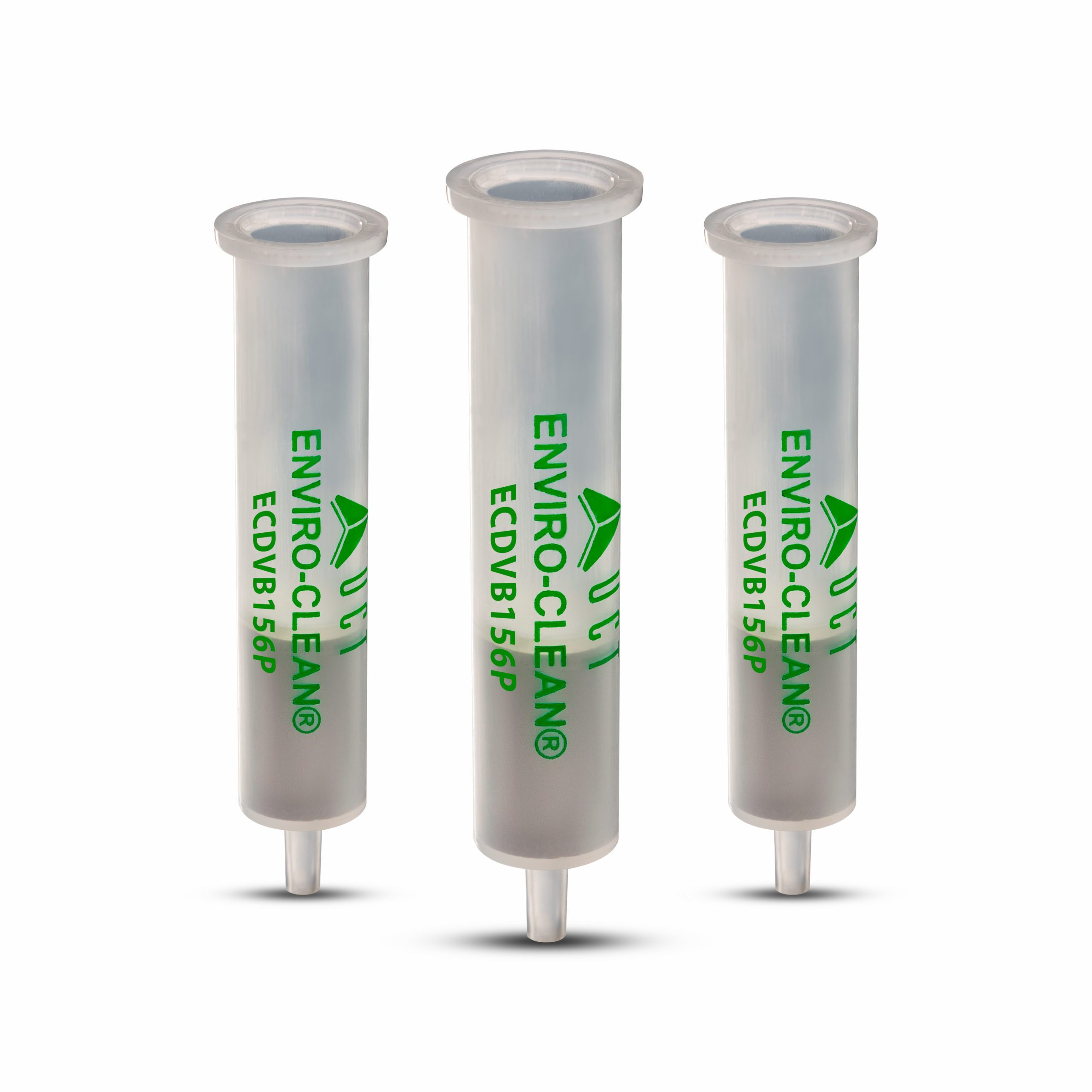
Enviro-Clean® DVB PE Frits 500 mg 6 mL
Polymeric styrene-divinylbenzene with polyethylene frits (ECDVB156P). Validated for EPA 537.1 drinking water PFAS analysis.
View Product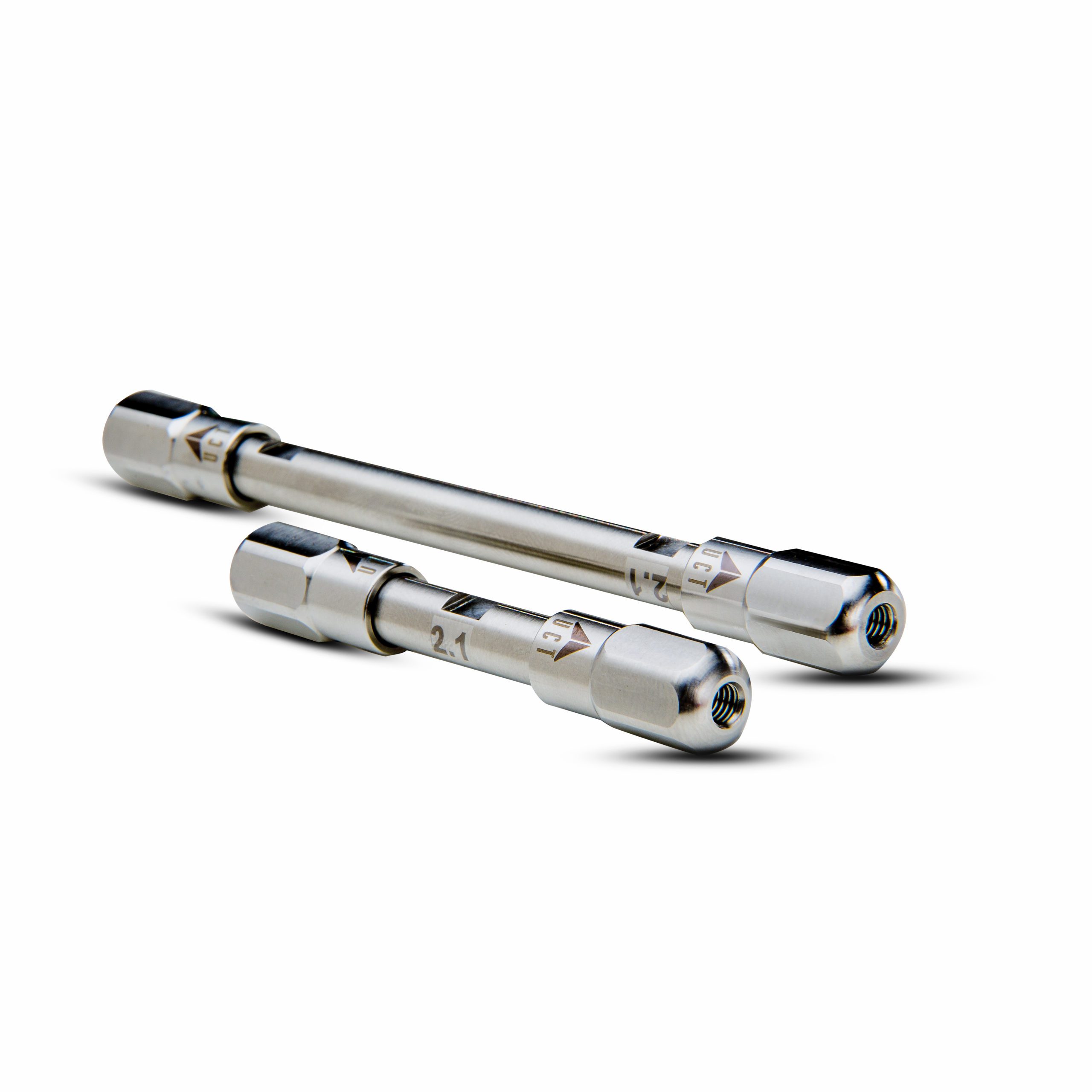
Selectra® C18 HPLC Columns
Analytical column (100 × 2.1 mm, 3 µm), delay column (50 × 4.6 mm, 5 µm), and guard column (10 × 2.0 mm, 3 µm) for EPA 537.1 LC-MS/MS analysis.
View ProductsFrequently Asked Questions
Common questions about EPA Method 537.1 and PFAS analysis in drinking water.
What is the difference between EPA 537, 537.1, and 533?
EPA 537 targets 14 PFAS compounds, while 537.1 expands coverage to 18 compounds — adding HFPO-DA (GenX), ADONA, 9Cl-PF3ONS, and 11Cl-PF3OUdS. EPA 533 focuses on shorter-chain PFAS, telomers, and precursors that cannot be measured by 537.1. All three methods are designed for drinking water analysis.
What SPE sorbent does EPA 537.1 require?
EPA 537.1 requires styrene-divinylbenzene (SDVB) solid-phase extraction cartridges. UCT offers both standard DVB (ECDVB156P) and highly cross-linked HLD (ECHLD156-P) sorbents, each with PE frits to eliminate PTFE contamination.
Why is a delay column needed for PFAS analysis?
A delay column is installed between the solvent mixer and the injector to separate PFAS contamination present in the mobile phase, solvent lines, and online degasser from the actual sample analytes. Without a delay column, system contamination can be concentrated on the analytical column and detected simultaneously with sample peaks.
Why must PTFE-free labware be used for EPA 537.1?
PTFE (polytetrafluoroethylene) is a fluoropolymer that can introduce background PFAS contamination into samples. EPA 537.1 requires PTFE-free SPE frits, collection tubes, autosampler vials, and HPLC solvent lines to ensure accurate trace-level measurements. UCT’s Enviro-Clean® cartridges use polyethylene (PE) frits for this reason.
What are the reporting limits for EPA 537.1?
Minimum reporting levels vary by compound and laboratory but typically range from 2–10 ng/L (ppt) for most analytes.
Can EPA 537.1 be used for non-drinking water samples?
EPA 537.1 is validated specifically for finished drinking water. For other matrices such as wastewater, soil, and biosolids, EPA Method 1633A is the appropriate multi-media PFAS method. For additional short-chain PFAS in drinking water, EPA Method 533 should be used.