
EPA Method 533
Determination of Per- and Polyfluoroalkyl Substances in Drinking Water by Isotope Dilution Anion Exchange Solid Phase Extraction and LC/MS/MS
What Is EPA Method 533?
EPA Method 533 is an analytical method for the determination of per- and polyfluoroalkyl substances (PFAS) in drinking water using isotope dilution anion-exchange solid phase extraction (SPE) and liquid chromatography/tandem mass spectrometry (LC-MS/MS). The method covers 25 PFAS compounds, with a focus on short-chain PFAS, fluorotelomer sulfonates, and precursor compounds that cannot be measured by EPA Method 537.1.
EPA 533 uses weak anion exchange (WAX) SPE cartridges — rather than the SDVB sorbent used in EPA 537.1 — to capture both anionic and neutral PFAS from drinking water samples. The method employs 16 isotopically labeled isotope dilution standards and 3 isotope performance standards to ensure optimum quantitation accuracy. With the EPA’s fifth Unregulated Contaminant Monitoring Rule (UCMR5) requiring analysis of 29 PFAS compounds, EPA 533 has become increasingly critical for drinking water testing laboratories.
- Targets 25 PFAS compounds including short-chain PFCAs, PFSAs, fluorotelomer sulfonates, and precursors
- Uses weak anion exchange (WAX) SPE for improved retention of short-chain and anionic PFAS
- Isotope dilution quantitation with 16 labeled standards for maximum accuracy
- Optimized chromatography for baseline separation of PFHxS and PFOS isomers
- Requires PTFE-free labware and PEEK HPLC tubing throughout the workflow
Why UCT for EPA 533?
Complete anion-exchange SPE and chromatography solutions for short-chain PFAS in drinking water.
UCT’s Enviro-Clean® WAX SPE cartridges combine strong reversed-phase interactions with high ion-exchange capacity, making them ideal for capturing the diverse range of anionic and neutral PFAS compounds targeted by EPA 533. Manufactured with polyethylene frits — not PTFE — these cartridges eliminate fluoropolymer background contamination at trace-level concentrations. Paired with Selectra® C18 HPLC columns and the PFAS Vacuum Manifold, UCT provides a complete sample-to-detection workflow for EPA 533. Browse the complete PFAS product catalog for additional accessories.
WAX Anion Exchange
Weak anion exchange sorbent with PE frits captures short-chain and anionic PFAS that SDVB cannot retain
Proven Recoveries
70–130% recovery with <20% RSD for all 25 analytes at 10 and 80 ng/L fortification levels
Isomer Resolution
Optimized chromatography achieves baseline separation of critical PFHxS and PFOS branched vs. linear isomers
Short-Chain Coverage
25 PFAS including PFBA, PFBS, fluorotelomer sulfonates, and precursors beyond EPA 537.1 scope
Target Analytes & MRM Transitions
25 PFAS compounds analyzed by EPA Method 533 with retention times and mass transitions.
| Analyte | R.T. (min) | Precursor Ion | Fragment Ion 1 | Fragment Ion 2 | R² |
|---|---|---|---|---|---|
| PFBA | 4.11 | 213.0 | 169.1 | — | 0.9984 |
| PFMPA | 4.79 | 229.0 | 85.0 | — | 0.9977 |
| PFPeA | 6.09 | 263.0 | 219.0 | 141.1 | 0.9987 |
| PFBS | 6.47 | 299.0 | 79.9 | 99.0 | 0.9989 |
| PFMBA | 6.72 | 279.1 | 85.0 | — | 0.9985 |
| PFEESA | 7.29 | 314.9 | 135.0 | 69.0 | 0.9987 |
| NFDHA | 7.80 | 295.0 | 201.0 | 85.0 | 0.9970 |
| 4:2 FTS | 7.96 | 327.0 | 307.1 | 81.0 | 0.9987 |
| PFHxA | 8.14 | 313.0 | 269.1 | 118.9 | 0.9971 |
| PFPeS | 8.37 | 349.0 | 80.0 | 99.1 | 0.9986 |
| HFPO-DA (GenX) | 8.67 | 285.0 | 169.0 | 185.1 | 0.9986 |
| PFHpA | 9.90 | 362.8 | 319.1 | 169.1 | 0.9987 |
| PFHxS | 10.01 | 399.0 | 80.0 | 99.0 | 0.9979 |
| ADONA | 10.09 | 377.1 | 251.0 | 85.0 | 0.9982 |
| 6:2 FTS | 11.31 | 427.1 | 407.0 | 81.0 | 0.9978 |
| PFOA | 11.37 | 412.8 | 369.1 | 169.2 | 0.9976 |
| PFHpS | 11.42 | 449.1 | 80.0 | 99.1 | 0.9967 |
| PFOS | 12.61 | 499.1 | 80.0 | 99.0 | 0.9979 |
| PFNA | 12.62 | 463.1 | 419.0 | 219.2 | 0.9978 |
| 9Cl-PF3ONS | 13.19 | 530.9 | 351.0 | — | 0.9980 |
| PFDA | 13.68 | 513.1 | 468.9 | 219.1 | 0.9988 |
| 8:2 FTS | 13.68 | 527.1 | 506.8 | 81.0 | 0.9979 |
| PFUnA | 14.61 | 563.1 | 518.9 | 268.8 | 0.9984 |
| 11Cl-PF3OUdS | 14.96 | 631.1 | 451.0 | — | 0.9977 |
| PFDoA | 15.40 | 612.9 | 569.0 | 319.1 | 0.9980 |
SPE Procedure
Step-by-step anion-exchange solid phase extraction protocol for EPA Method 533 using Enviro-Clean® WAX cartridges.
Sample Pretreatment
- Verify that the sample containing 1 g/L ammonium acetate has a pH between 6.0 and 8.0 (adjust with acetic acid as needed)
- Fortify LFB, LFSM, and LFSMD samples with analyte primary dilution standard
- Add isotope dilution analogue primary dilution standard to each sample (including LRB), cap and invert to mix
SPE Conditioning
- Rinse SPE cartridge (ECWAX156-P) with 10 mL methanol
- Rinse the cartridge with 10 mL of 0.1 M pH 7 phosphate buffer — do not allow the water to drop below the top edge of the packing
- Close the valve and add 2–3 mL of phosphate buffer to the reservoir, fill remaining volume with reagent water
- Note: Do not allow packing material to go dry during conditioning. If it dries, repeat conditioning.
Sample Extraction & Drying
- Attach a large-volume sample transfer tube to the cartridge; place the stainless-steel end into the sample bottle
- Adjust vacuum for a flow rate of approximately 5 mL/min (rates above 5 mL/min may cause low recovery)
- After sample passes through, rinse the bottle with 10 mL of 1 g/L ammonium acetate and draw through the cartridge
- Add 1 mL methanol to the sample bottle and draw through to remove residual salt and water
- Dry the cartridge under high vacuum (15–20 in Hg) for 5 minutes
Elution
- Insert a collection rack with 15 mL polypropylene tubes into the extraction manifold
- Add 5 mL of methanol containing 2% NH₄OH (v/v) to the sample container, cap and thoroughly rinse the sides
- Pull the elution solvent through the transfer tubes and cartridges at a low vacuum (dropwise flow)
- Repeat the bottle rinse and elution with a second 5 mL aliquot of elution solvent
- Note: Use fresh elution solvent due to the volatility of NH₄OH.
Concentration & Reconstitution
- Concentrate the extract to dryness under a gentle stream of nitrogen in a heated water bath (55–60 °C)
- Reconstitute the extract with 1.0 mL of 20% reagent water in methanol (v/v)
- Add isotope performance standards and vortex
- Transfer an aliquot to a polypropylene autosampler vial (PTFE-free)
LC-MS/MS Conditions
Chromatographic and mass spectrometry parameters used for EPA 533 analysis.
HPLC Parameters
Mobile Phase Gradient
| Time (min) | A: 20 mM NH₄OAc (%) | B: Methanol (%) |
|---|---|---|
| 0.0 | 95 | 5 |
| 2.0 | 60 | 40 |
| 18.0 | 5 | 95 |
| 20.0 | 5 | 95 |
| 20.1 | 95 | 5 |
| 25.0 | 95 | 5 |
MS/MS Parameters
Delay Column Note: A short C18 delay column is installed after the solvent mixer and before the sample injector to separate system PFAS contamination from sample analytes. All PTFE solvent lines should be replaced with PEEK tubing. If the source temperature is too high, this may result in poor signal for HFPO-DA.
SPE Recovery Results
Method performance data for Enviro-Clean® WAX cartridges in reagent water.
| Analyte | Recovery (%) Low | RSD (%) Low | Recovery (%) High | RSD (%) High |
|---|---|---|---|---|
| PFBA | 115.9 | 9.2 | 108.0 | 10.7 |
| PFMPA | 102.2 | 4.7 | 100.5 | 1.2 |
| PFPeA | 100.9 | 5.1 | 100.7 | 2.3 |
| PFBS | 107.7 | 5.9 | 108.8 | 2.1 |
| PFMBA | 103.3 | 5.5 | 103.2 | 0.5 |
| PFEESA | 101.3 | 5.3 | 103.8 | 1.9 |
| NFDHA | 98.1 | 5.5 | 95.7 | 2.3 |
| 4:2 FTS | 107.3 | 5.9 | 106.0 | 1.9 |
| PFHxA | 100.5 | 5.7 | 102.2 | 2.3 |
| PFPeS | 107.4 | 6.0 | 112.3 | 2.7 |
| HFPO-DA | 106.1 | 7.1 | 105.1 | 2.5 |
| PFHpA | 106.6 | 5.0 | 107.5 | 2.0 |
| PFHxS | 104.1 | 5.3 | 106.3 | 1.4 |
| ADONA | 99.9 | 5.2 | 99.9 | 1.8 |
| 6:2 FTS | 127.0 | 13.2 | 102.9 | 1.5 |
| PFOA | 106.5 | 5.7 | 106.2 | 1.9 |
| PFHpS | 101.1 | 5.8 | 99.5 | 3.7 |
| PFOS | 101.7 | 5.0 | 100.5 | 2.1 |
| PFNA | 99.9 | 5.6 | 99.1 | 2.6 |
| 9Cl-PF3ONS | 105.1 | 5.1 | 103.3 | 5.2 |
| PFDA | 106.5 | 4.8 | 106.9 | 2.4 |
| 8:2 FTS | 108.9 | 4.4 | 108.4 | 1.9 |
| PFUnA | 110.0 | 5.2 | 108.5 | 2.5 |
| 11Cl-PF3OUdS | 101.1 | 5.3 | 97.4 | 10.7 |
| PFDoA | 109.1 | 4.9 | 107.2 | 2.0 |
Low Fortification: 10 ng/L (n=6) | High Fortification: 80 ng/L (n=6) — Reagent water
Recommended Products for EPA Method 533
UCT offers a complete range of consumables designed to meet EPA Method 533 requirements.
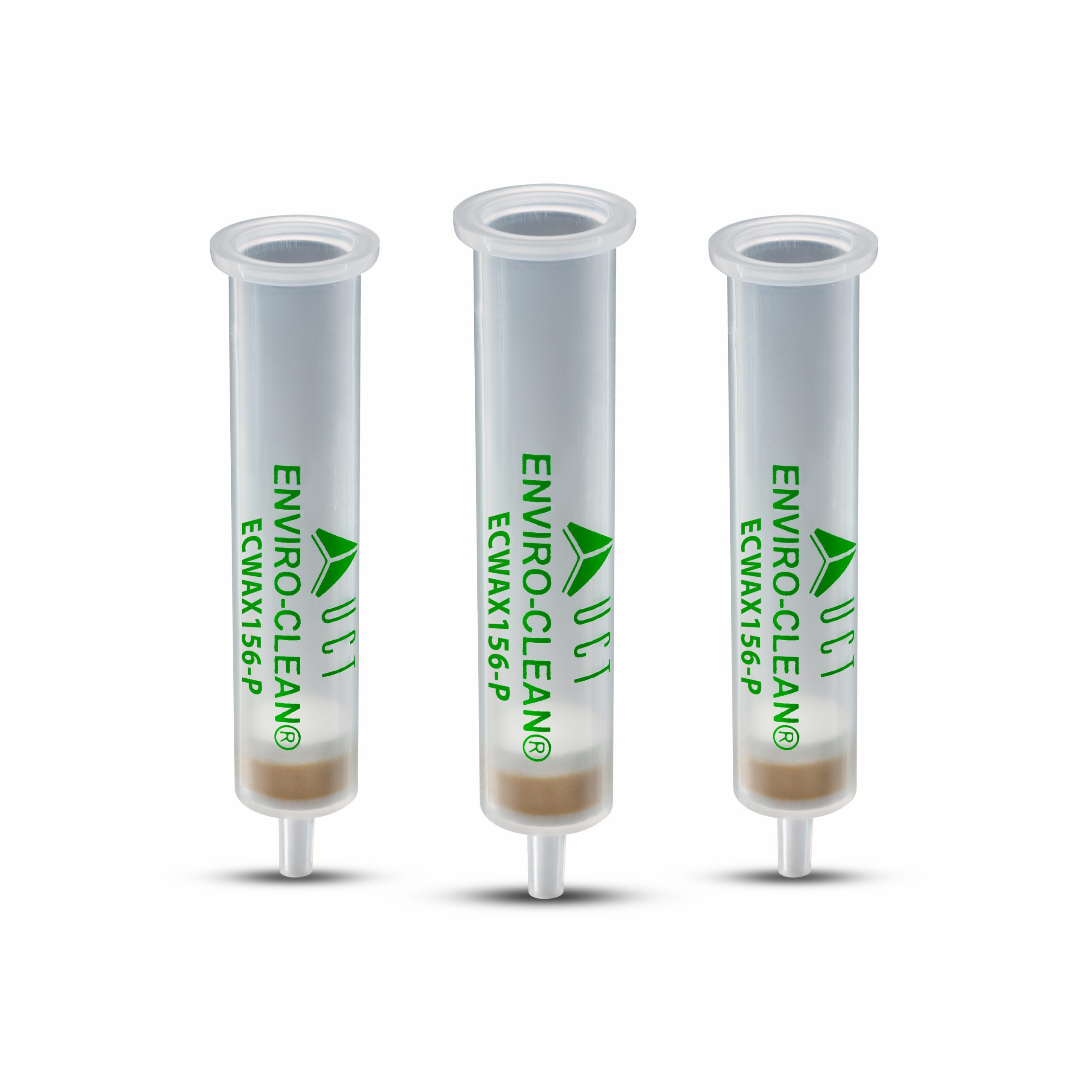
Enviro-Clean® WAX PE Frits 500 mg 6 mL
Polymeric weak anion exchange with polyethylene frits (ECWAX156-P). Required for EPA 533 PFAS extraction from drinking water.
View Product
PFAS Vacuum Manifold — 16 Position
Glass block manifold system designed for PFAS testing with minimal background contamination for EPA 533 extractions.
View Product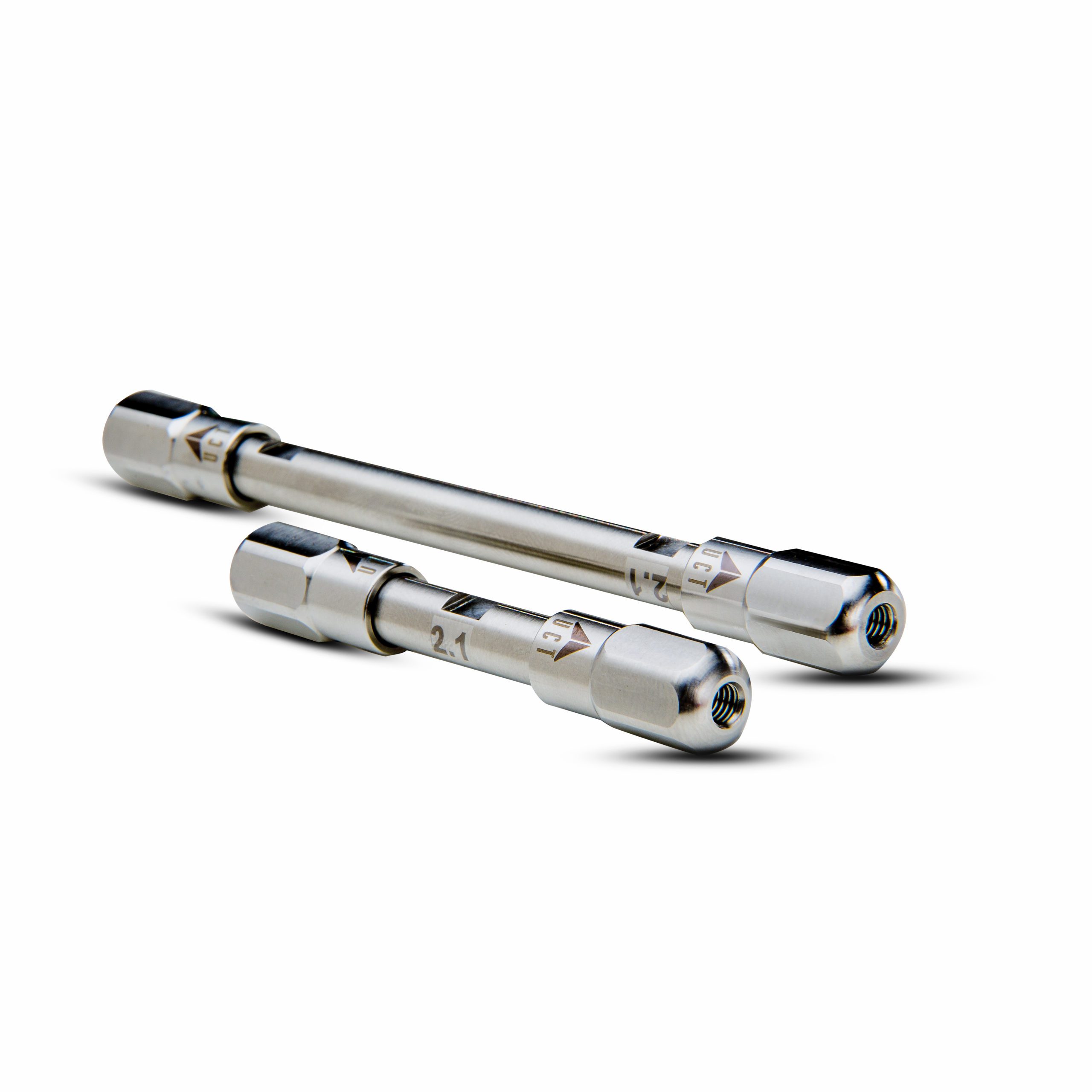
Selectra® C18 HPLC Columns
Analytical column (100 × 2.1 mm, 3 µm), delay column (50 × 4.6 mm, 5 µm), and guard column (10 × 2.0 mm, 3 µm) for EPA 533 LC-MS/MS analysis.
View ProductsFrequently Asked Questions
Common questions about EPA Method 533 and PFAS analysis in drinking water.
What is the difference between EPA 533 and EPA 537.1?
EPA 537.1 targets 18 PFAS using SDVB (styrene-divinylbenzene) SPE cartridges, while EPA 533 covers 25 PFAS using weak anion exchange (WAX) SPE. EPA 533 is specifically designed for short-chain PFAS, fluorotelomer sulfonates, and precursor compounds that cannot be retained or measured by EPA 537.1. Both methods are validated for finished drinking water.
Why does EPA 533 use WAX instead of SDVB cartridges?
Short-chain PFAS compounds like PFBA, PFBS, and fluorotelomer sulfonates are poorly retained on standard SDVB sorbents due to their high polarity and low hydrophobicity. WAX (weak anion exchange) sorbent provides both reversed-phase interactions and ion exchange capacity, enabling effective retention of these challenging analytes.
What is the role of isotope dilution in EPA 533?
EPA 533 uses 16 isotopically labeled isotope dilution standards (IDS) added to samples before extraction to correct for analyte losses during sample preparation and matrix effects during LC-MS/MS analysis. Three additional isotope performance standards (IPS) are added post-extraction to monitor instrument performance.
Why is a delay column needed for PFAS analysis?
A delay column is installed between the solvent mixer and the injector to separate PFAS contamination present in the mobile phase, solvent lines, and online degasser from the actual sample analytes. Without a delay column, system contamination can be concentrated on the analytical column and detected simultaneously with sample peaks.
What is UCMR5 and how does it relate to EPA 533?
The fifth Unregulated Contaminant Monitoring Rule (UCMR5) requires public water systems to monitor for 29 PFAS compounds. Many of these compounds — particularly the short-chain PFAS and fluorotelomer sulfonates — are covered by EPA 533, making it essential for laboratories performing UCMR5 compliance monitoring alongside EPA 537.1.
Can EPA 533 be used for non-drinking water samples?
EPA 533 is validated specifically for finished drinking water. For other matrices such as wastewater, soil, and biosolids, EPA Method 1633A is the appropriate multi-media PFAS method. For additional long-chain PFAS coverage in drinking water, EPA Method 537.1 should be used.