
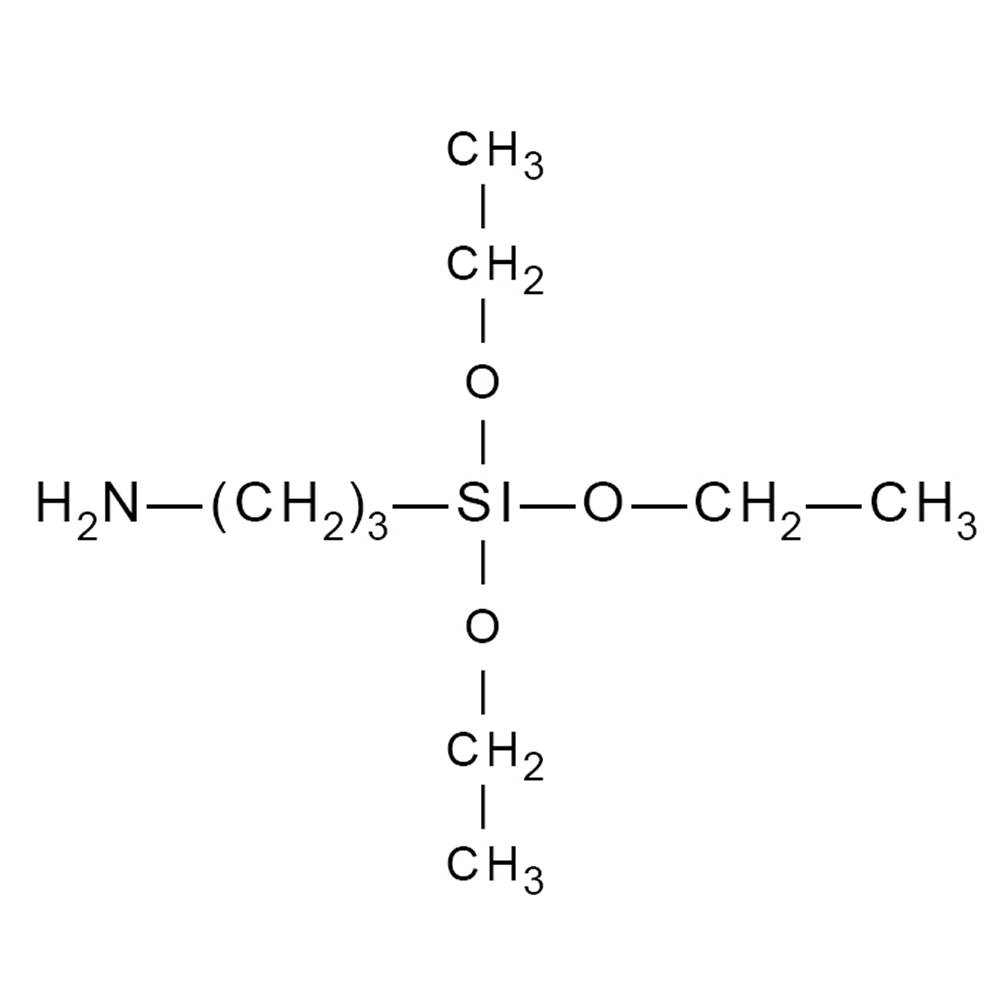
3-Aminopropyltriethoxysilane
3-Aminopropyltriethoxysilane (APTES), CAS 919-30-2, is a versatile organofunctional silane coupling agent that bridges inorganic surfaces and organic matrices. It contains both a hydrolyzable triethoxysilane group and a reactive primary amine moiety, making it ideal for surface modification, adhesion promotion, and chemical functionalization.
Key Features & Benefits:
- Offers strong covalent bonding to metal oxides, silica, glass, ceramics, and other siliceous substrates
- The amino group enables further chemical grafting, crosslinking, or coupling to polymers, biomolecules, and coatings
- Useful in biosensor fabrication, microfabrication, adhesives, hybrid composites, and surface passivation
- Stable handling if stored under inert atmosphere; moisture-sensitive
Typical Applications:
- Silanization of glass, silicon, or metal oxide surfaces
- Primer or adhesion promoter in coatings, sealants, and adhesives
- Immobilization of biomolecules (proteins, enzymes, DNA) onto surfaces
- Composite materials and nanocomposite interface engineering
- Microelectronic and MEMS surface functionalization
Technical Data (typical):
- Molecular formula: C₉H₂₃NO₃Si
- Molecular weight: ~221.37 g/mol TCIchemicals.com+2Sigma-Aldrich+2
- Boiling point: ~217 °C ChemicalBook+1
- Density: ~0.946 g/mL at 25 °C ChemicalBook+2gelest.com+2
- Refractive index: ~1.42 gelest.com+2ChemicalBook+2
Handling & Storage:
Store in a cool, dry place under inert gas (e.g. nitrogen). Avoid moisture exposure as hydrolysis will degrade the material. Use in a dry, controlled environment.
- For international ordering, contact your International Distributor.
- For sample requests, please contact your Regional Sales Representative.
3-Aminopropyltriethoxysilane (APTES), CAS 919-30-2, is a versatile organofunctional silane coupling agent that bridges inorganic surfaces and organic matrices. It contains both a hydrolyzable triethoxysilane group and a reactive primary amine moiety, making it ideal for surface modification, adhesion promotion, and chemical functionalization.
Key Features & Benefits:
- Offers strong covalent bonding to metal oxides, silica, glass, ceramics, and other siliceous substrates
- The amino group enables further chemical grafting, crosslinking, or coupling to polymers, biomolecules, and coatings
- Useful in biosensor fabrication, microfabrication, adhesives, hybrid composites, and surface passivation
- Stable handling if stored under inert atmosphere; moisture-sensitive
Typical Applications:
- Silanization of glass, silicon, or metal oxide surfaces
- Primer or adhesion promoter in coatings, sealants, and adhesives
- Immobilization of biomolecules (proteins, enzymes, DNA) onto surfaces
- Composite materials and nanocomposite interface engineering
- Microelectronic and MEMS surface functionalization
Technical Data (typical):
- Molecular formula: C₉H₂₃NO₃Si
- Molecular weight: ~221.37 g/mol TCIchemicals.com+2Sigma-Aldrich+2
- Boiling point: ~217 °C ChemicalBook+1
- Density: ~0.946 g/mL at 25 °C ChemicalBook+2gelest.com+2
- Refractive index: ~1.42 gelest.com+2ChemicalBook+2
Handling & Storage:
Store in a cool, dry place under inert gas (e.g. nitrogen). Avoid moisture exposure as hydrolysis will degrade the material. Use in a dry, controlled environment.