
Homogeneous Platinum Catalysts
High-purity homogeneous platinum catalysts for hydrosilylation cure systems — engineered for a wider curing range, lower concentrations, and cleaner reaction profiles than conventional condensation or peroxide cure alternatives.
Homogeneous Catalysts for Superior Performance
UCT Specialties platinum catalysts are homogeneous — meaning they are soluble in the reaction medium. Unlike heterogeneous catalysts, which are insoluble and depend on irregular surface effects for their activity, homogeneous catalysts deliver more consistent, predictable performance across a wide range of silicone cure applications.
UCT’s platinum catalyst line is specifically designed for hydrosilylation cure systems, offering significant performance advantages over traditional condensation cure (tin and zinc catalyzed) and peroxide cure systems.
Advantages Over Conventional Cure Systems
Hydrosilylation cure systems catalyzed by UCT platinum complexes outperform both condensation and peroxide cure alternatives across a range of critical performance metrics.
vs. Condensation Cure (Tin & Zinc Catalyzed)
- Wider range of curing temperatures: room temperature to >100°C
- Lower catalyst concentrations (5–30 ppm vs. 100–300 ppm)
- No volatile byproducts
- Smoother reaction profiles
vs. Peroxide Cure Systems
- Lowest cure temperature possible
- No acidic byproducts (e.g., benzoic acid from benzoyl peroxide cure)
- No “frothing” from oxygen byproduct
- No oxidative degradation of cured elastomer
Platinum Catalysts Offered by UCT Specialties
Eight catalyst formulations covering the full spectrum from highest reactivity room-temperature addition cures to low-reactivity high-temperature extruded silicone applications.
| Description | Application | Part No. | Min. % Pt Weight |
|---|---|---|---|
| Platinum Divinyl Complex, Xylene, Neutral | Highest reactivity, for room temperature addition cure. | PC072 | 2% Pt |
| Optically clear, highest reactivity, for applications where cured silicones require high transparency. | PC074 | 2% Pt | |
| Platinum Divinyl Complexes, vinyl terminated polydimethylsiloxane, Neutral | Intermediate reactivity, useful for slow room temperature cures and moderate (30–100°C) higher temperature cures. | PC075 | 2% Pt |
| PC075.3 | 3% Pt | ||
| PC076 | 1% Pt | ||
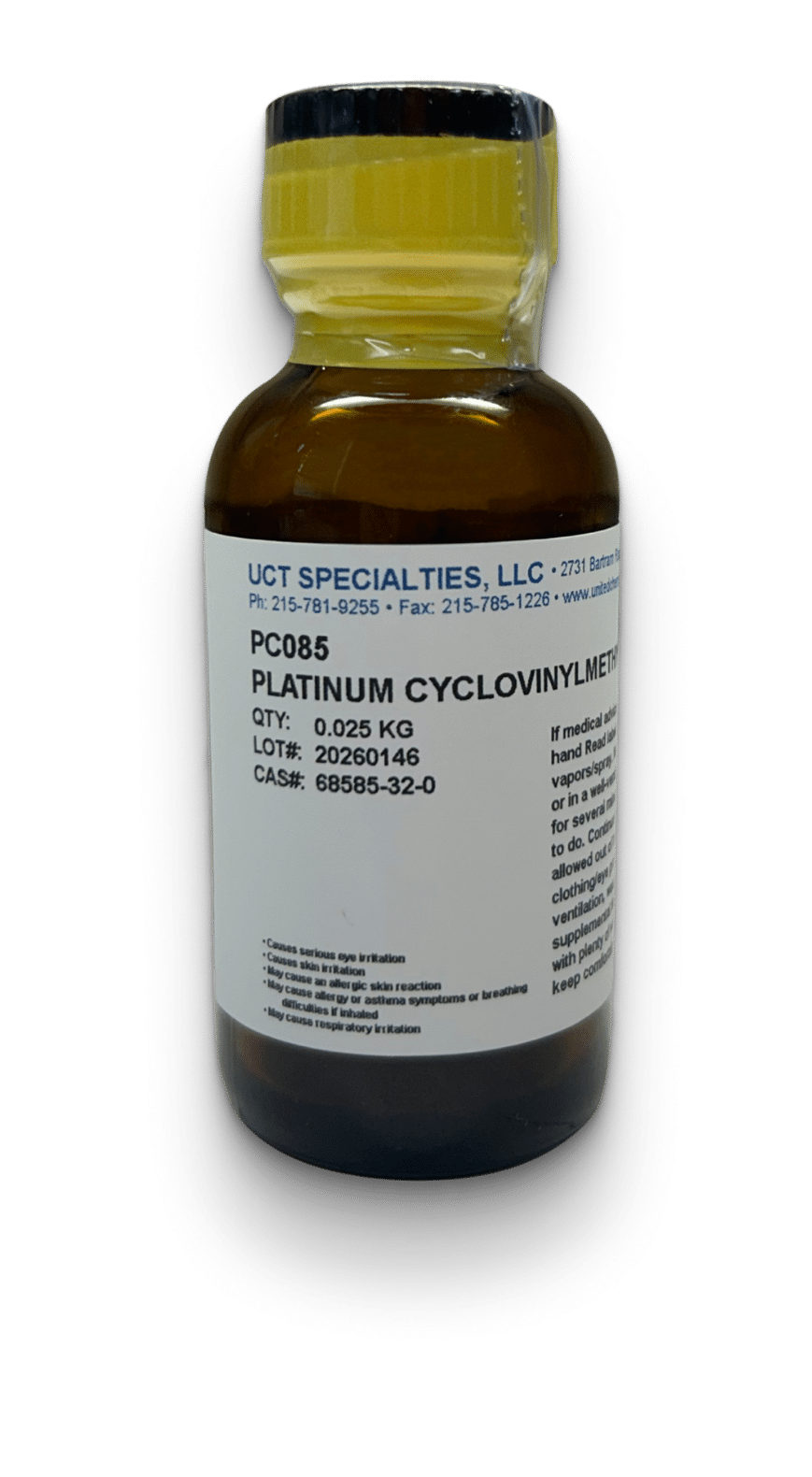
| Platinum Cyclovinyl Complexes, cyclic vinylmethylsiloxanes, Neutral | Lower reactivity, for high temperature (>100°C) extruded silicone formulations. | PC085 | 2% Pt |
| Platinum Octanol / Octanal Complexes, Octanol / Octanal | Low reactivity, for high temperature (>100°C) extruded silicone formulations. Useful as fire retardant in silicone resins. | PC088.3 | 2% Pt |
Products for Use with UCT Platinum Catalysts
UCT Specialties offers a complete range of hydrosilicones, vinyl fluids, and inhibitors designed to work in conjunction with our platinum catalyst line.
| Part No. | Viscosity (cSt) | Methyl Hydro | Sp. Gravity | Refractive Index | Flash Point | Application |
|---|---|---|---|---|---|---|
| PS118 | 2–5 | 100% | 0.90 | 1.382 | 50°C | Blowing agent crosslinkers |
| PS119 | 18–24 | 100% | 0.99 | 1.395 | 100°C | Blowing agent crosslinkers |
| PS120 | 15–40 | 100% | 0.99 | 1.395 | 150°C | Blowing agent crosslinkers |
| Part No. | Viscosity (cSt) | Methyl Hydro | Sp. Gravity | Refractive Index | Flash Point | Application |
|---|---|---|---|---|---|---|
| PS122.5 | 10–15 | 50–55% | 0.99 | 1.394 | 70°C | RTV crosslinkers for Pt addition cure |
| PS123 | 25–30 | 30–35% | 0.99 | 1.399 | 125°C | RTV crosslinkers for Pt addition cure |
| PS123.5 | 25–35 | 15–18% | 0.99 | 1.400 | >94°C | RTV crosslinkers for Pt addition cure |
| PS123.8 | 7,500 ± 2,500 | 0.5–1.0% | 0.97 | 1.404 | 300°C | RTV crosslinkers for Pt addition cure |
| PS124.5 | 250–275 | 3–4% | 0.97 | 1.404 | >66°C | RTV crosslinkers for Pt addition cure |
| Part No. | Viscosity (cSt) | Vinyl (Wt %) | Sp. Gravity | Primary Use |
|---|---|---|---|---|
| PS441 | 100 | 0.999 | 0.97 | Base polymer / liquid RTV blend |
| PS441.2 | 200 | 0.675 | 0.97 | Base polymer / liquid RTV blend |
| PS442 | 500 | 0.405 | 0.97 | Base polymer / liquid RTV blend |
| PS443 | 1,000 | 0.297 | 0.97 | Base polymer / liquid RTV blend |
| PS444 | 5,000 | 0.162 | 0.97 | High strength RTV systems |
| PS445 | 10,000 | 0.135 | 0.97 | High strength RTV systems |
| PS447.6 | 65,000 | 0.081 | 0.97 | High strength RTV systems |
| PS448 | 100,000 | 0.054 | 0.97 | High strength RTV systems |
| PS448.5 | 165,000 | 0.041 | 0.97 | High consistency RTV systems |
| PS449 | 600,000 | — | 0.98 | High consistency RTV systems |
| Part No. | Viscosity (cSt) | Sp. Gravity | Primary Use |
|---|---|---|---|
| PS496 | 4,000–6,000 | 1.02 | High strength RTV systems, reinforcer |
Platinum catalyst inhibitor for controlled pot life in addition cure systems.
Platinum catalyst inhibitor for controlled pot life in addition cure systems.
Frequently Asked Questions
Common questions about UCT’s platinum catalyst line.
What does “homogeneous” mean for a platinum catalyst?
A homogeneous catalyst is soluble in the reaction medium, unlike heterogeneous catalysts which are insoluble and rely on irregular surface effects. Homogeneous catalysts deliver more consistent, predictable activity throughout the reaction.
What catalyst concentrations are needed for hydrosilylation cure?
UCT platinum catalysts are effective at 5–30 ppm, significantly lower than condensation cure systems which typically require 100–300 ppm of tin or zinc catalyst.
Which catalyst is best for room temperature addition cure?
PC072 and PC074 offer the highest reactivity and are specifically designed for room temperature addition cure. PC074 is the preferred choice for applications requiring high optical transparency in the cured silicone.
Which catalyst is recommended for high-temperature extruded silicone?
PC085 (Platinum Cyclovinyl Complex) and PC088.3 (Platinum Octanol/Octanal Complex) are both designed for high-temperature (>100°C) extruded silicone formulations. PC088.3 also serves as a fire retardant in silicone resins.
What are inhibitors used for in platinum catalyst systems?
Inhibitors such as D6210 and PS925 are used to control pot life in addition cure systems, giving formulators the working time needed before cure initiates.
Can I get special pricing for volume orders?
Yes. UCT offers special pricing for volume purchases and standing orders. Contact your local sales representative for more information on special pricing qualifications.
Ready to Order Platinum Catalysts?
Browse the complete UCT Specialties platinum catalyst line or contact your local sales representative for application guidance and volume pricing.