
Ultra Pure Silica Metal Scavengers
UCT’s metal scavengers are built on ultra pure silica refined over 40 years of chemistry and manufacturing, delivering targeted, reliable removal of catalytic metal residues for regulatory compliance.
Shop Metal Scavengers →Development Kit for Screening
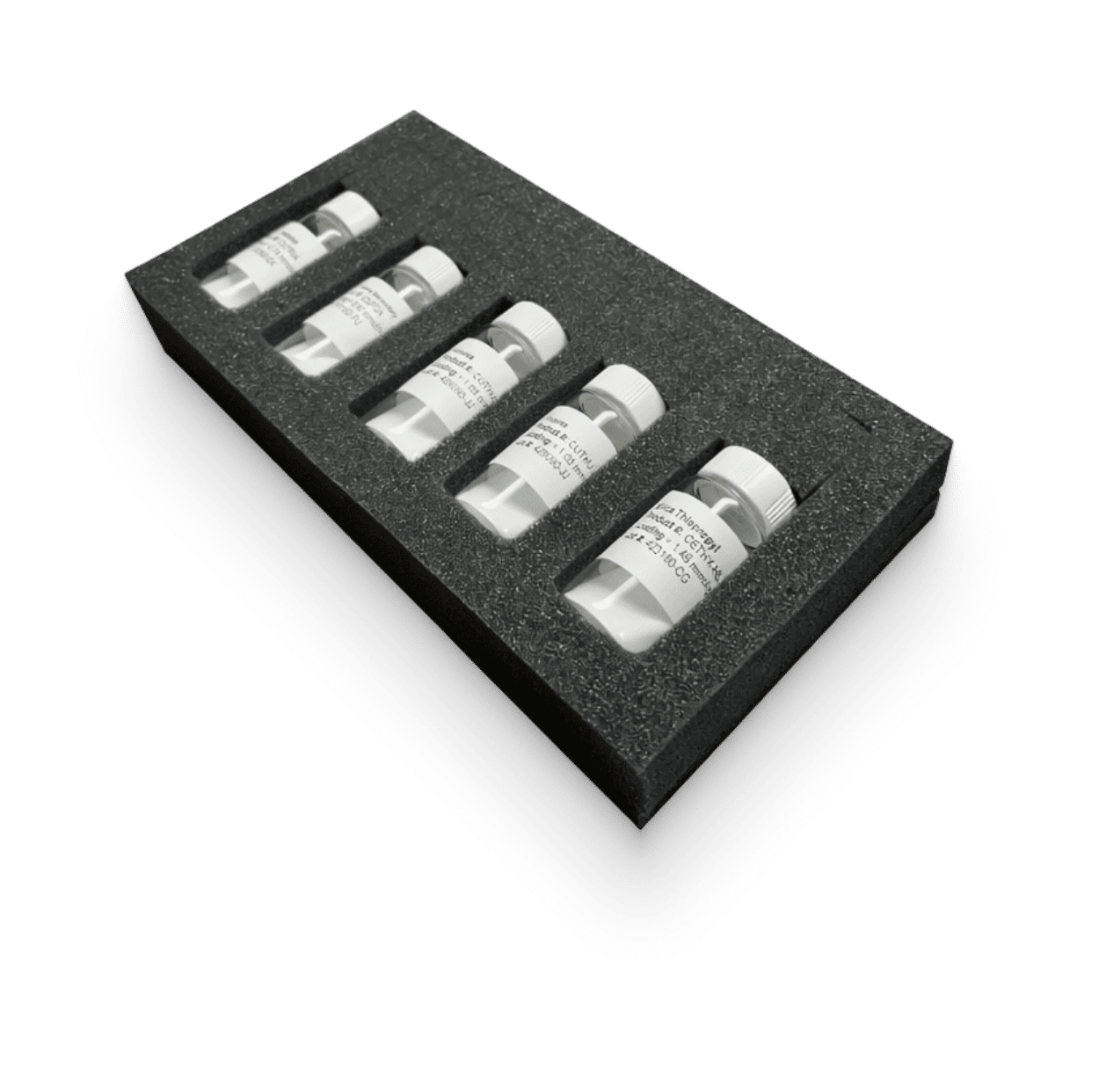
The perfect starting point for method development. Test multiple scavenger chemistries to find the optimal solution for your specific metal removal needs.
5 Chemistries
Screen every scavenger type in a single kit — Thiol, Thiourea, Triamine, PSA, and Triacetic Acid.
Screen & Optimize
5g of each chemistry provides enough material for multiple screening experiments and optimization runs.
The Problem with Residual Metals
Catalytic reactions like Suzuki Coupling, Buchwald–Hartwig, Heck, and Olefin Metathesis leave behind trace metals that can compromise your process and products.
Transition-metal-catalyzed reactions are fundamental to modern pharmaceutical and fine chemical synthesis, but they introduce a critical downstream challenge: residual metal contamination. Palladium, ruthenium, rhodium, copper, nickel, and other catalytic metals persist in reaction mixtures at levels that can exceed regulatory limits set by ICH Q3D guidelines, the FDA, and the EMA. These trace metal impurities pose risks to patient safety in pharmaceutical applications and can interfere with subsequent synthetic steps, degrade product stability, and damage sensitive analytical instrumentation such as HPLC columns and mass spectrometers. Traditional purification methods like recrystallization, liquid-liquid extraction, and activated carbon treatment often fail to reduce metal concentrations to the low parts-per-million (ppm) levels required for regulatory compliance. UCT’s silica-based metal scavengers provide a targeted, efficient solution — using functionalized silica sorbents to selectively capture and remove specific metal contaminants from reaction mixtures in a simple add, stir, and filter workflow.
Patient Safety
Residual metals can compromise API quality and patient safety.
Regulatory Delays
Non-compliance with ICH Q3D, FDA, and EMA standards delays approval.
Costly Rework
Metal contamination causes yield losses and expensive reprocessing.
Instrument Damage
Metals can damage analytical instrumentation and columns.
| Reaction Type | Residual Metal | Recommended Scavenger |
|---|---|---|
| Suzuki Coupling | Silica Thiol | |
| Buchwald–Hartwig Amination | Thiol / Thiourea | |
| Heck Reaction | Silica Thiol | |
| Sonogashira | Thiol / Thiourea | |
| Olefin Metathesis | Silica Thiol | |
| Knoevenagel Condensation | Silica Thiol |
Industries We Serve
UCT metal scavengers deliver reliable performance across pharmaceutical, chemical, and analytical applications.
Metal scavenging is a critical purification step across multiple industries where trace metal contamination can compromise product quality, regulatory compliance, or analytical accuracy. In pharmaceutical manufacturing, ICH Q3D establishes permitted daily exposure (PDE) limits for elemental impurities in drug products, making effective metal removal essential for API approval and commercialization. Beyond pharma, fine chemical producers, contract research organizations (CROs), and analytical laboratories all rely on metal scavengers to ensure the purity and integrity of their products and data. UCT’s CLEAN-UP® metal scavenger product line serves all of these applications with five distinct silica-based chemistries, each engineered for targeted removal of specific metal species.
Pharmaceutical & API Synthesis
Remove toxic metal contaminants, meet regulatory compliance (ICH Q3D), and produce high-quality active pharmaceutical ingredients.
Fine & Specialty Chemicals
Enhance purity, minimize contamination, and improve production efficiency for specialty chemical manufacturing.
Analytical Chemistry
Protect valuable HPLC columns and instrumentation while delivering reliable results by removing metal impurities before analysis.
CLEAN-UP® Metal Scavengers
Each scavenger is engineered with a specific ligand and metal preference for targeted removal of catalytic residues.
UCT’s CLEAN-UP® metal scavenger portfolio consists of five functionalized silica sorbents, each bonded with a different chelating ligand that determines its metal selectivity and binding strength. The silica backbone provides high surface area, controlled porosity, and mechanical stability, while the bonded functional groups — ranging from sulfur-based thiol and thiourea ligands to nitrogen-based amine ligands to oxygen-based carboxylate groups — offer complementary selectivity profiles that collectively cover the full spectrum of catalytic metals encountered in pharmaceutical and chemical synthesis. For laboratories unsure which scavenger is best suited to their application, the Metal Scavengers Development Kit provides 5g of all five chemistries for rapid screening and method optimization. Browse the complete metal scavenger product catalog for individual products and bulk ordering options.
Silica Thiopropyl (Thiol)
Broad-spectrum metal capture. Universal scavenger suitable for mixed or unknown metal residues with fast kinetics under mild conditions.
Silica Thiourea
High selectivity for palladium. Exceptional Pd affinity makes it ideal for coupling reactions requiring very low final Pd limits.
Silica Triamine
High-density chelation. Multiple nitrogen donors form multidentate complexes for enhanced metal capture, especially for metals with open coordination sites.
Silica Diamine (PSA)
Dual metal and acid interaction. Removes metals and acidic impurities in a single step, valuable when crude mixtures contain multiple impurity classes.
Silica Triacetic Acid
Hard-metal remover. Oxygen donors from carboxylate groups form stable complexes with hard Lewis-acidic metals, ideal for base-metal or lanthanide impurities.
Why Choose UCT Metal Scavengers?
Built on high-purity silica with controlled loading and pore architecture for consistent, reliable performance.
UCT’s metal scavengers are manufactured using high-purity, irregular silica gel with controlled pore sizes and surface areas optimized for metal binding efficiency. Unlike resin-based alternatives that can swell in organic solvents, leach contaminants, or exhibit slow kinetics, silica-based scavengers maintain their physical integrity across a wide range of solvent systems and provide rapid metal capture at ambient temperature. The covalently bonded functional groups are permanently anchored to the silica surface, ensuring that no ligand leaching occurs during use — a critical requirement for pharmaceutical applications where any additional impurity introduction is unacceptable. From small-scale research experiments to multi-kilogram manufacturing runs, UCT metal scavengers deliver predictable, reproducible performance with a simple add, stir, and filter workflow that integrates seamlessly into existing purification processes.
No Leaching
Metal–silica bonds are fully anchored, preventing contamination of APIs or filtrates.
Targeted Selectivity
Functionalized groups capture metals precisely while preserving complete API recovery.
Rapid Kinetics
Fast metal binding at ambient temperature minimizes process time.
Universal Solvent Compatibility
Performs seamlessly in both aqueous (pH 2–12) and organic systems.
Simple & Scalable
Add, stir, filter. Easily scalable from R&D to manufacturing scale.
Consistent Loading
Precisely controlled loading levels allow predictable stoichiometry and performance.
Simple 4-Step Process
Integrate metal scavengers seamlessly into your existing purification workflow.
Metal Scavenging
Treat crude mixture with selected CLEAN-UP® scavenger to capture catalytic metals.
Filtration & Rinse
Remove scavenger by filtration and rinse to maximize product recovery.
SPE Polishing
Apply SPE cartridge to remove organic byproducts, ligands, and residual salts.
Isolation
Concentrate and isolate final material by crystallization or evaporation.
Frequently Asked Questions
Common questions about metal scavengers and their applications.
What metals can be removed with silica-based scavengers?
UCT scavengers effectively remove a wide range of catalytic metals including Pd, Ru, Rh, Ir, Cu, Ni, Fe, Ag, Hg, and many others depending on the scavenger chemistry selected.
How do I choose the right scavenger?
Selection depends on the target metal(s) and reaction type. Thiol is a good universal first choice, Thiourea excels at Pd removal, and Triacetic Acid targets hard metals like Ca, Mg, and lanthanides. The Development Kit lets you screen all five chemistries to find the best match for your application.
What solvents are compatible?
UCT metal scavengers work in both aqueous systems (pH 2–12) and common organic solvents including THF, DCM, acetonitrile, methanol, ethanol, and many others.
What is the typical usage ratio?
A common starting point is 2–5 mmol equivalents of scavenger relative to the estimated metal content. The Development Kit allows you to optimize for your specific application.
Can scavengers be used in flow chemistry?
Yes, UCT silica-based scavengers are fully compatible with flow chemistry platforms and can be packed into columns for continuous processing.
Do you offer bulk quantities?
Yes, metal scavengers are available from 5g research quantities up to multi-kilogram bulk orders for manufacturing scale applications. Contact your local UCT sales representative for bulk pricing and lead times.
Ready to Remove Metal Contaminants?
Explore our complete line of metal scavengers or start with the Development Kit to find the optimal solution for your application.
Exploring other purification solutions? Forensic & Clinical SPE · QuEChERS Extraction Kits · Environmental SPE